Practice Management
How Payer Contract Blind Spots Quietly Drain Your Reimbursements


A 99215 goes out on a Tuesday. Three weeks later it comes back paid as a 99214. No denial, no letter, no request for records. Just a smaller number on the remit, sitting in a batch of forty other lines that all look fine.
Nobody flags it, because nothing was denied. The biller posts it, because the payment matches what the payer said it would pay. The claim closes at the lower level unless someone goes looking.
Denials are loud. They land in a work queue, somebody owns them, and there's an appeal deadline on the calendar. Underpayments are quiet. They get posted, reconciled, and forgotten, and the one document that could catch them lives in a filing cabinet.
The Contract Nobody Reads Twice
Strip away the legal language and every commercial payer contract is a rate sheet. It says what the payer owes you for each CPT code, how that rate moves over time, and what either side has to do to change it. It's the only document that defines what "paid correctly" means for your practice.
Most practices negotiate it once, sign it, and file it. The billing system never sees it. Payments get posted against whatever the payer sends, and the only check is whether the claim was paid at all.
MGMA asked practice leaders about this in a February 2025 Stat poll. Thirty percent said they audit payer payments against their contracts every month. Eighteen percent do it quarterly, and another thirty percent check once a year. One respondent put it plainly: "It's ridiculous how often [payer] payments are incorrect."
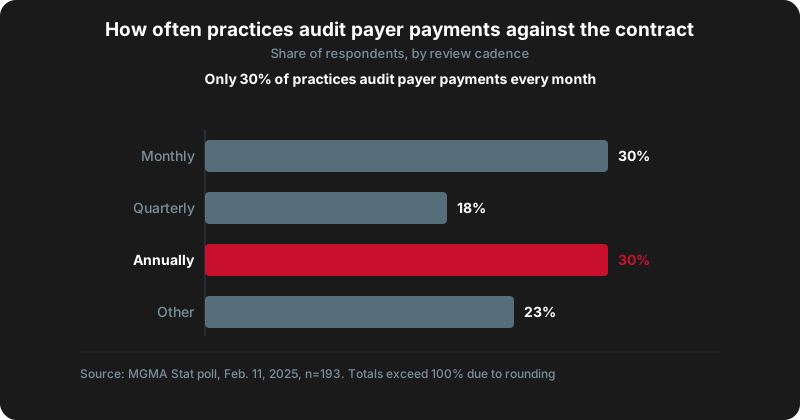
An annual audit means twelve months of shortfalls can stack up before anyone sees the pattern. By the time someone does, some of those claims may be past the payer's window for disputes.
Downcoding Is Now Written Into Policy
For years, an underpayment usually meant a fee schedule loaded wrong or a modifier that fell off. Since 2025, two of the largest commercial payers have made it policy.
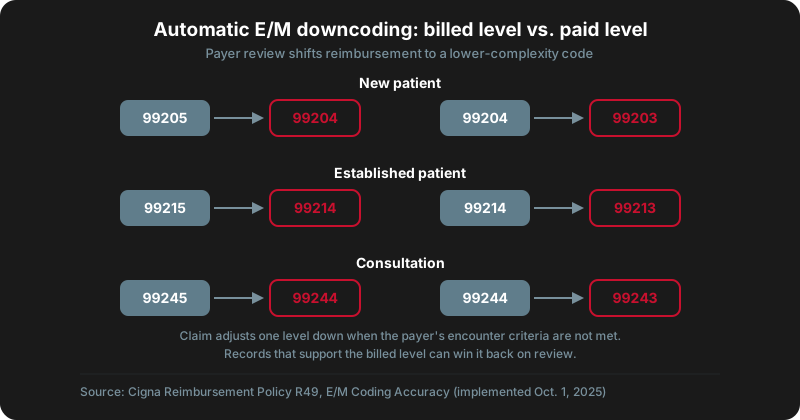
Cigna's Reimbursement Policy R49, which the payer began applying in October 2025, targets claims billed at 99204, 99205, 99214, 99215, 99244, and 99245. When a claim doesn't meet what Cigna calls its encounter criteria, it gets paid one level down. A 99215 is paid as a 99214. A 99205 becomes a 99204. If your records support the level you billed, you can send them in and recover the difference, but you have to notice the adjustment first.
Aetna runs its own version. After a pilot in 12 states, it expanded its review of level 4 and 5 office visits to nearly all of its commercial markets in March 2025, with no notification on the individual claim. A practice that wins 75 percent of its appeals over a year can ask to be taken out of the program. That tells you where the burden sits.
Emergency department codes aren't on Cigna's list, so my own shifts don't feel this directly. Primary care, cardiology, and orthopedics carry the weight of it, because level 4 and 5 visits are where the complex patients live. A diabetic with CKD and new chest pain is a 99215 because the medical decision-making says so. The AAFP pushed back on Cigna over exactly that point: a rule that judges a visit from the codes on the claim can't see the MDM in the note. Cigna paused the policy for fully insured HMO plans in California after the state medical association took it to regulators, and paused it for PPO plans for 30 days while the state insurance department reviewed it. Maryland went further. Its insurance regulator fined Cigna $80,000 this spring, ordered it to stop automatic downcoding in the state, and then extended the same rule to every insurer there. Everywhere else, R49 is still on the books.
We've written before about why physicians bill below what their notes support. Automatic downcoding takes a second cut out of the visits that were coded correctly.
Your Rate Moves When Medicare Moves
Plenty of commercial contracts don't list a dollar amount per code. They pay a percentage of the Medicare fee schedule, something like 115 percent. It sounds like a rate that keeps up with costs. Medicare's own numbers say otherwise.
The conversion factor, the dollar multiplier behind every physician fee, dropped from $33.2874 in 2024 to $32.3465 in 2025, a 2.83 percent cut. It came back to $33.4009 in 2026 for most physicians. CMS also trimmed work RVUs 2.5 percent on codes that aren't billed by time, so many procedure rates moved less than that headline number suggests.
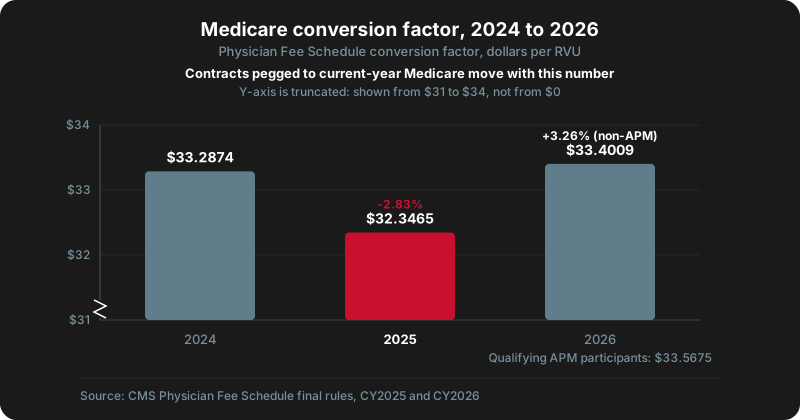
Check which year's Medicare schedule your contract actually references. Some peg to the current year, so every cut flows straight through to your commercial rate with no renegotiation and no notice. Others are locked to a fee schedule from years ago, which means the rate hasn't moved since the day you signed.
Neither version keeps pace. The AMA calculates that Medicare physician pay fell 33 percent from 2001 to 2025 after adjusting for inflation. A contract tied to that number is tied to a rate that loses ground every year.
The Clauses That Do the Quiet Damage
The rate is only part of the contract. The rest is machinery that decides how the rate changes, and most of it was written by the payer.
Renewal comes first. Most payer agreements are evergreen, meaning they renew automatically each year unless someone gives notice inside a narrow window before the anniversary date. Miss the window and the old rates roll forward another year. Nobody at the practice decided to accept them. The calendar did.

Amendments are the next one. Many contracts let the payer change its fee schedule or reimbursement policies with written notice and no signature from you. Those notices show up as letters, portal bulletins, or a paragraph in a provider newsletter. If nobody reads them, the new terms take effect anyway.
Then there are "lesser of" clauses, which pay the lower of your billed charge or the contracted rate. If your charge master hasn't been updated in years, the rate you negotiated never kicks in, because your own charge is lower.
Network rental, sometimes called a silent PPO, is the last one I look for. Some contracts let the payer lease your negotiated discount to other plans and third-party administrators. You end up giving a discount to a payer you never signed with.
None of this is hidden. It's all in the contract, in the part nobody opens after the signature page.
What to Check Before Your Next Renewal
Start with a spreadsheet, not software. Pull every active commercial contract and write down four things for each one: the renewal date, the notice window to renegotiate or terminate, how the rate is set (a fixed fee schedule, or a percentage of Medicare and which year), and whether the contract allows network rental. Put the notice deadlines on a calendar that someone actually watches.
Next, load the contracted rates for your top 20 codes by volume into your practice management system. Most PM systems can flag a payment that comes in under the expected amount. If yours can't, a monthly export compared against the fee schedule does the same job with a little more effort.
Then look hard at level 4 and 5 visits from Cigna and Aetna. Pull every 99204, 99205, 99214, and 99215 from the last quarter and compare the billed code to the paid code. If a pattern shows up, appeal with the note attached, and make sure the documentation spells out the MDM clearly enough for a reviewer who never met the patient.
And open the mail. Give one person the job of reading payer bulletins and amendment letters, and have them log anything that changes a rate or a policy.
Where Sovereign RCM Fits
Sovereign RCM applies payer rules, modifiers, and bundling logic to every claim before it goes out, and each claim carries an evidence pack showing why the code was chosen and where in the note it came from. That's the documentation a downcoding appeal needs, already assembled. During the 90-day pilot, the appliance calibrates to your payer contracts using your historical claims and denial data. The contracts and the PHI stay on-premise, like everything else the appliance handles.
If you haven't opened your payer contracts since you signed them, start with the renewal dates. If you want a second set of eyes on what your remits say against what your contracts promise, talk to our team or read about the 90-day pilot program, which runs in shadow mode alongside your current billing.
Sources
- Medical Group Management Association. Regular auditing of payer payments crucial to ensure accurate reimbursement. MGMA Stat, February 2025.
- Cigna Healthcare. Reimbursement Policy R49: Evaluation and Management Coding Accuracy. Cigna, 2025.
- American Academy of Family Physicians. Cigna's downcoding policy gets pushback from physician groups. FPM Getting Paid blog, 2025.
- Indiana State Medical Association. Aetna E/M downcoding program update. ISMA e-Reports, June 12, 2025.
- Centers for Medicare & Medicaid Services. Medicare Physician Fee Schedule Final Rules, CY 2025 and CY 2026. CMS, 2024 and 2025.
- American Medical Association. Medicare physician pay has plummeted since 2001. Find out why. AMA, April 2025.
- California Medical Association. Update: CMA receives clarification on scope of Cigna downcoding policy pause. CMA, November 2025.
- ADA News. Maryland orders Cigna to stop automatic downcoding, issues $80,000 fine. American Dental Association, April 2026.
About the Author

Faizan G. Arif, MD
Chief Executive Officer
Board-certified EM physician and the clinical visionary behind Sovereign RCM. Faizan has coded and billed in many busy emergency departments and has had a particular interest in denial patterns stemming from personal experiences as a patient.