Practice Management
Why Credentialing Delays Are Costing Your Practice More Than You Know

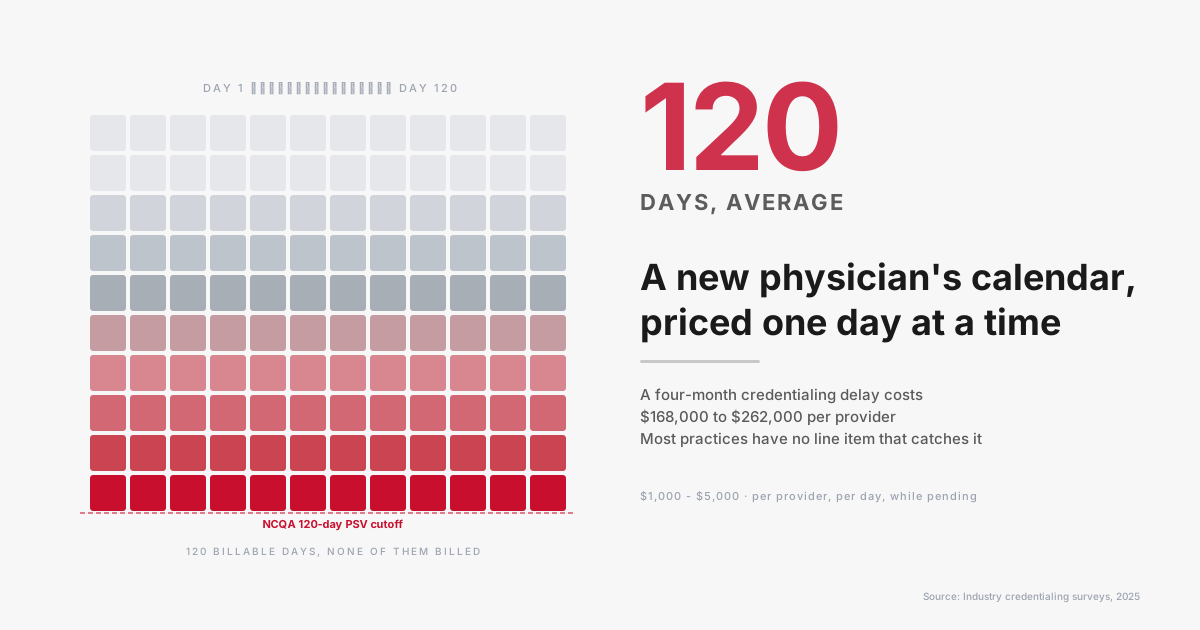
There is a category of cost in healthcare that does not show up on any P&L line item. It accumulates in queues, in pending applications, in physicians who are on payroll but cannot bill. Credentialing is the system that produces it, and most practice owners only see the cost after the damage has already been done.
A new physician is hired. The clinic is fully booked. Patients are calling. And then, somewhere between the offer letter and the first billable visit, the same thing happens that happens at almost every practice in the country: credentialing stalls. The physician is on salary, on benefits, and on malpractice insurance, and they cannot see insured patients. The clock runs. The numbers move in the wrong direction.
Industry data puts the lost clinical revenue at $83,000 to $122,000 for a single provider over a four-month delay. Once you fold in the salary you are still paying, the administrative effort, the overtime, and the second-order damage to patient access and staff morale, the realistic cost lands between $168,000 and $262,000 per provider. For a 5-physician practice that runs into even one credentialing delay per year, that is a quarter-million dollars vanishing into a queue. For a 20-physician group, it's a million to two million annually.
The Cost That Doesn't Show Up on Your P&L
If you ask a practice owner how much revenue they lost to credentialing last year, the honest answer is usually "I don't know." There is no expense line called "credentialing slippage." The cost hides in productivity numbers, in lower patient satisfaction, in the cost of replacing the front desk staffer who burned out covering for the physician who could not start on time. It hides specifically because the credentialing process does not fail loudly. It just takes longer than anyone planned for, and the difference between planned and actual gets absorbed by the rest of the operation.
A useful question to ask, before going any further: what does your practice's average time-to-first-billable-visit look like, measured in days from hire to first reimbursed claim? Most practices cannot answer that question. The number is not tracked.
What 90 to 150 Days Actually Looks Like
The headline number that gets quoted in the industry is "credentialing takes 90 to 150 days." That is true for the typical case. The full distribution is wider. The faster end, where well-run practices live, is 30 to 60 days. The slower end, which more practices land in than would like to admit, is 180 days. NCQA, the body that accredits most managed care organizations, recently shortened the Primary Source Verification window from 180 to 120 days. That tightens one part of the process but does nothing to reduce the payer-side queue depth.
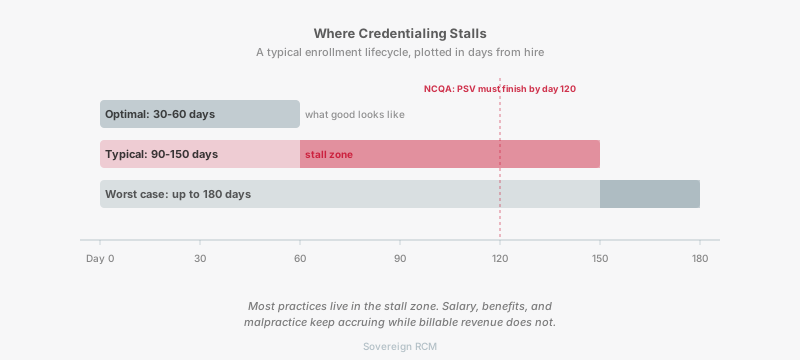
The 90-to-150-day band is not a static waiting period. It is a sequence of partial steps that depend on one another. CAQH attestation goes in. Documents get requested. Primary source verifications run in parallel against medical school transcripts, DEA licenses, state licenses, malpractice claims history, and NPDB reports. Each payer has its own queue, its own document standards, and its own reviewer assignment. A missing exclusion screening from 30 days ago is enough to send an application to the back of the line for another 30 to 60 days.
The geometry matters. Each restart adds days, not hours. The system has no fast retry path.
Why It Stalls
Three things, mostly, and they compound.
The first is that credentialing is not one process. It's many processes, running in parallel, each with its own state machine. The average physician maintains relationships with 13 different hospitals, health plans, and other healthcare organizations. The average new hire needs to be enrolled with 10 to 15 different insurance payers. Each one wants slightly different versions of the same underlying documents. Most practices manage this by hand, in a spreadsheet or in a credentialing app that was never designed for the volume.
The second is documentation chaos. The set of documents required is large, and the version control is brittle. A state license uploaded in March is stale by May. A malpractice claims history pulled six months ago is no longer authoritative. The reviewer flags it, the application halts, and someone has to re-pull the document, re-attest, and re-submit. Nothing tells you upstream that this is about to happen.
The third is that the people who run credentialing tend to leave. A 2025 industry survey found that 51 percent of credentialing and payer enrollment teams experienced staff turnover in the previous 12 months. When the credentialing specialist leaves, the institutional knowledge of which reviewer at which payer responds to email and which one requires a fax goes with them. Replacing that knowledge takes months. The incoming physician does not have months.
Thirteen Payers, One Physician
The radial geometry of credentialing is what makes it expensive. Picture it: one physician at the center, 13 payer nodes around them, and a separate set of document handoffs running on every spoke. The work is not 13 times one process. It is 13 different processes that share an input set.
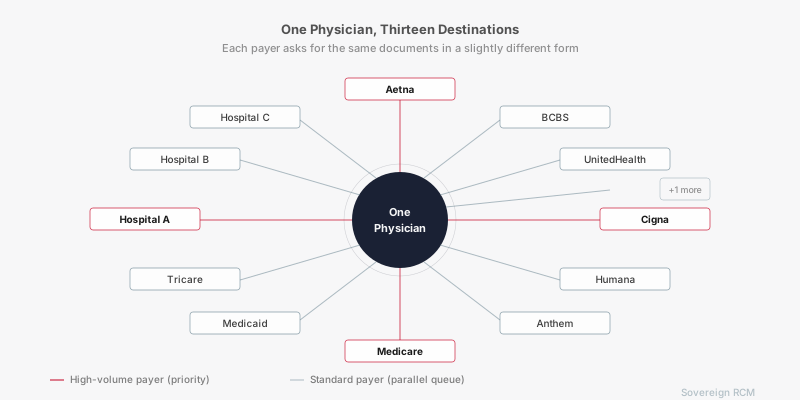
The implication is that any improvement that operates per payer scales linearly. A standardized document repository helps. Pre-credentialing, where you start the process before the hire date, helps. Building a relationship with a specific reviewer at a specific payer helps with one payer's queue. None of these are silver bullets because the underlying structure is fan-out by design.
A Four-Month Delay, Itemized
The headline cost of $168,000 to $262,000 for a four-month delay is a stacked number. It breaks down into five components, none of which would look catastrophic on its own.
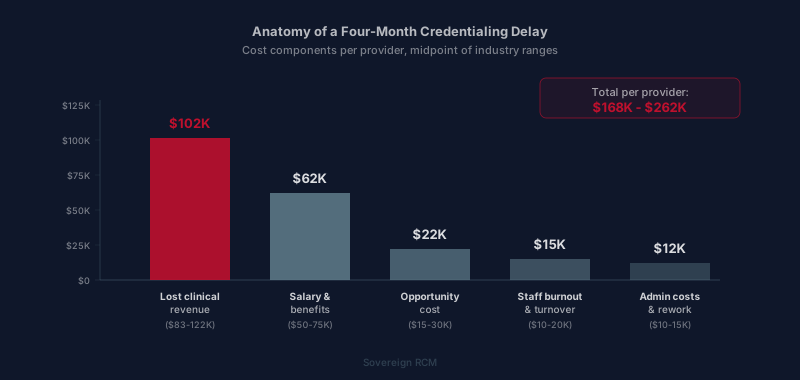
Lost clinical revenue is the largest component, at $83K to $122K, because the physician is sitting on a calendar that should be billing $1,000 to $5,000 a day. Salary and benefits during the non-productive window add another $50K to $75K. Administrative costs from follow-up, rework, and resubmission run $10K to $15K. Patients who got referred out to a competitor while your roster was constrained cost another $15K to $30K in foregone revenue. Staff overtime and the burnout-driven turnover that follows add a final $10K to $20K.
The total is not theoretical. A 2025 industry survey found that 43 percent of healthcare organizations lose $50,000 or more per month to credentialing issues. One in four loses more than $100,000 monthly. One in five hospitals loses more than $1 million annually. The distribution is heavily skewed toward "more than people realize."
The Ripple That Compounds
The financial leak is the visible piece. The structural damage is harder to see and longer-lived.
Patient access degrades first. Your existing physicians are already overbooked. The new hire was supposed to relieve that pressure. Instead, patients keep waiting weeks for appointments. Some of them stop waiting and go to a competing practice. The revenue loss from your established panel quietly piles on top of the unbilled revenue from the new physician.
Staff burnout follows. Front desk staff, nurses, and administrative teams can see the bottleneck building. They are trying to push credentialing through, but they cannot. The stress is real, and turnover in your administrative team gets worse. Now you are also hiring and training replacements, which costs money and pulls more time from the people who are still there.
The recruited physician notices, too. They were promised a fast onboarding. Some of them take other jobs while waiting, or tell other physicians about the experience. Your workplace reputation absorbs a hit that takes a long time to repair.
What Practices That Handle It Well Actually Do
The practices that have brought their time-to-first-billable-visit closer to 30 to 60 days are not doing anything exotic. They are treating credentialing the way they would treat any other revenue-critical function.
The biggest single change is dedicated ownership. Top-performing practices assign a credentialing specialist whose only job is credentialing, not a part-time slice of someone else's responsibilities. That person learns each payer's reviewer cadence, document format, and queue behavior. They proactively address issues before those issues become bottlenecks because they are paid to see them coming.
The second change is centralized document management. Instead of each physician keeping their own file folder, there is a single repository where every credentialing-relevant document is organized, versioned, and ready to ship. When a new physician arrives, the document checklist is clear and gets completed in days, not weeks.
Automated tracking helps too. Modern credentialing software tracks status across multiple payers, sends reminders when documents are about to expire, and surfaces stalled applications. It will not fix the underlying queue, but it will keep small delays from turning into large ones.
The least technical change, and the one most often skipped, is payer relationship management. Senior staff maintain ongoing contact with specific reviewers at specific payers. When a file is stuck, a phone call to the right person frequently moves it. These relationships take years to build, and they pay back every single time a physician is onboarded.
The practices that get this right also start credentialing before the hire date. Documents get collected, applications get pre-staged, and the first wave goes out the day the physician signs. That single change can take 30 days off the timeline.
The Hidden Line Item
The uncomfortable thing about credentialing slippage is that it is one of the most fixable revenue leaks in a practice's operations, and it stays unfixed because nobody owns it. It does not have a line item. It does not show up in a dashboard. It just absorbs into productivity, satisfaction, and staff turnover, and gets written off as the cost of doing business.
It is not the cost of doing business. It is the cost of an unowned process.
If your practice is currently losing revenue to credentialing delays, the recovery is straightforward: assign one person to own it, centralize the documents, track the queue, build the payer relationships, and start before the hire date. The numbers move quickly once the process becomes someone's job. The question worth asking is not whether you can afford to improve credentialing. It is whether you can keep affording the unowned version.
If you want to walk through what credentialing slippage looks like in your specific practice, reach out to the team. We can put numbers to the cost and show you what to change first.
About the Author

Navid M. Rahman, PE
Chief Operating Officer
Licensed PE with 15+ years managing regulated infrastructure. Navid translates complex compliance and procurement into structured AI deployment playbooks.