Sovereign RCM
Building an Air-Gapped AI System for Medical Billing
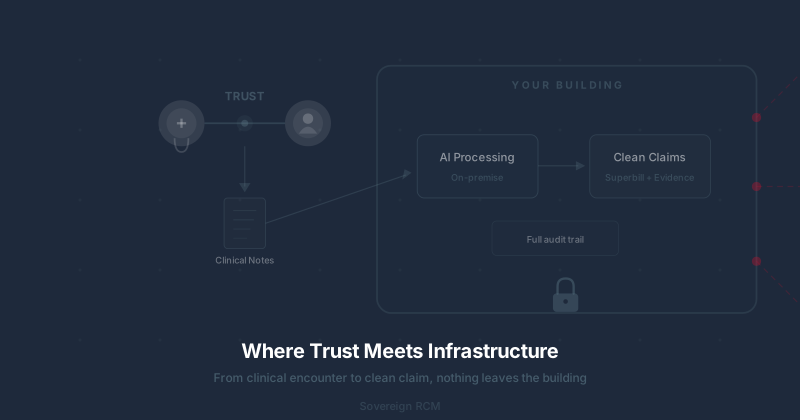
As a psychiatrist, I have spent my career thinking about trust. The relationship between a physician and a patient depends on it entirely. A teenager sitting across from me during a session needs to know that what they share stays between us. That foundation of confidentiality is not a luxury in medicine. It is the mechanism through which care actually works.
When I joined Sovereign RCM as Director of Internal Operations, I brought that same lens to a question most physicians never think to ask: where does our billing data actually go once a clinical note is signed?
The vulnerability we overlook
On a broader scale, healthcare is in an incredibly vulnerable position when it comes to data security. The patients who need the most protection, those navigating mental health challenges, chronic conditions, or socially stigmatized diagnoses, are the ones who suffer most when their records are exposed.
The Change Healthcare breach in early 2024 disrupted claims processing for roughly half of all U.S. healthcare transactions. Practices across the country could not bill, could not verify insurance, and could not be certain their patients' records were safe. This was not a hypothetical scenario. It happened, and it revealed how deeply most practices depend on infrastructure they do not own or control.
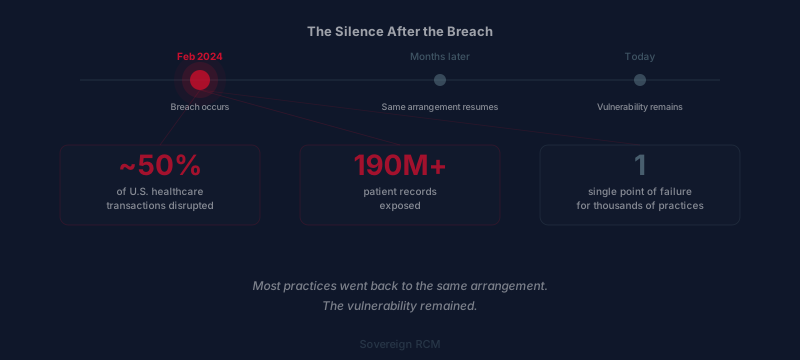
What struck me most was not the scale of the disruption. It was the silence afterward. Most practices went back to the same arrangement: sending clinical documentation to third-party servers, trusting vendors they have never visited, relying on systems they have no visibility into. The vulnerability remained, and so did the risk to patients.
Why I think about this differently than an engineer
As a Child and Adolescent trained psychiatrist, I truly appreciate that data security is not just a technical problem. It is a clinical one. When a patient or their family hesitates to be fully honest during a session because they are uncertain about where those notes end up, that hesitation affects diagnosis, treatment planning, and outcomes. It is a bio-psycho-social problem in the truest sense.
The psychological dimension is real: patients who fear exposure withhold information. The social dimension is real: a teenager whose psychiatric records are breached may face stigma at school or in their community. And the biological dimension follows, because incomplete disclosure leads to incomplete care.
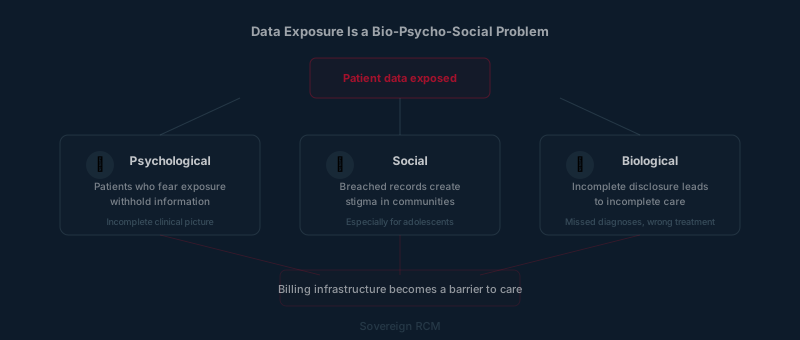
It is a firm belief of mine that the billing infrastructure a practice uses should never become a barrier to honest clinical encounters. Yet that is exactly what happens when patient records travel through systems the practice cannot see or control.
What air-gapping means in plain terms
An air-gapped system runs entirely inside your building. The AI that processes billing data operates on hardware in your facility, disconnected from the internet. Patient records do not leave the practice. There is no cloud server storing your clinical notes, no external vendor transmitting protected health information, no third-party data center holding records alongside thousands of other practices.
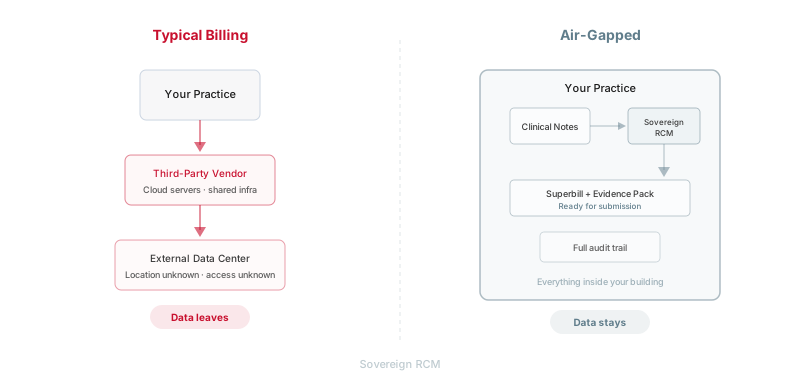
For physicians, this is not about technical sophistication. It is about chain of custody. You know where the data is. You know who can access it. You control what happens to it after a claim is processed. That level of ownership is something most practices gave up years ago in exchange for convenience, and I believe they should not have to.
The question worth asking
If you run a practice in any specialty, I would encourage you to ask your billing team a straightforward question: where does our patient data live right now?
Most practice managers can name their billing company. Fewer can tell you which data center stores their records, what the vendor's breach notification timeline is, or whether clinical notes are transmitted overseas for processing. That gap between trust and verification is exactly where patient risk accumulates.
Closing that gap does not require a practice to become a technology company. It requires choosing infrastructure that keeps patient data inside the building, under the practice's control, processed by systems the practice owns. The technology exists to do this without sacrificing the billing improvements that practices need: fewer denials, less undercoding, faster reimbursements.
Looking ahead
I got into medicine to help people, particularly young people working through the most difficult periods of their lives. Billing operations were never supposed to be the part of practice that creates risk for patients. But when data security becomes a clinical concern, physicians have a responsibility to engage with it.
At Sovereign RCM, we are building the kind of infrastructure I wish had existed when I first started thinking about these questions. I hope that more physicians, regardless of specialty, will begin asking where their patients' data goes and whether the answer aligns with the standard of care they provide in every other part of their practice.
If this resonates with how you think about your own practice, we would welcome that conversation.
About the Author
Zubair Khan, DO
Director of Internal Operations
Board-certified psychiatrist with dual certification in General Psychiatry and Child & Adolescent Psychiatry. Zubair is a Residency Program Director, Assistant Professor, and recognized Top Doctor for Kids (2023, 2024). He brings a clinician's perspective on data security, patient trust, and operational governance to Sovereign RCM.