Practice Management
The Prior Authorization Problem: What Every Practice Owner Should Know

It's 4:45 PM on a Friday.
Your last patient is checking out. Your staff is winding down. And then it happens:
"Doctor, insurance needs a prior authorization for the medication you prescribed."
You already know how this story goes.
A form gets submitted. Then another. Maybe a peer-to-peer call gets scheduled for next Tuesday at 1:30 PM, right in the middle of clinic. The patient waits. Your staff follows up. Days pass.
And in the background, something subtle but important is happening: care is being delayed, not because of medicine, but because of process.
What Prior Authorization Was Supposed to Be
Prior authorization didn't start out as the villain.
At its core, it was meant to prevent unnecessary or duplicative care, ensure expensive treatments were clinically appropriate, and help control rising healthcare costs. In theory, those are reasonable goals. Most physicians actually agree with them.
But somewhere along the way, prior authorization expanded from a targeted safety check into a routine barrier across everyday care.
What It Has Become
Today, prior authorization touches almost everything: medications you've prescribed a hundred times, imaging studies that follow well-established guidelines, chronic therapies your patient has already been stable on.
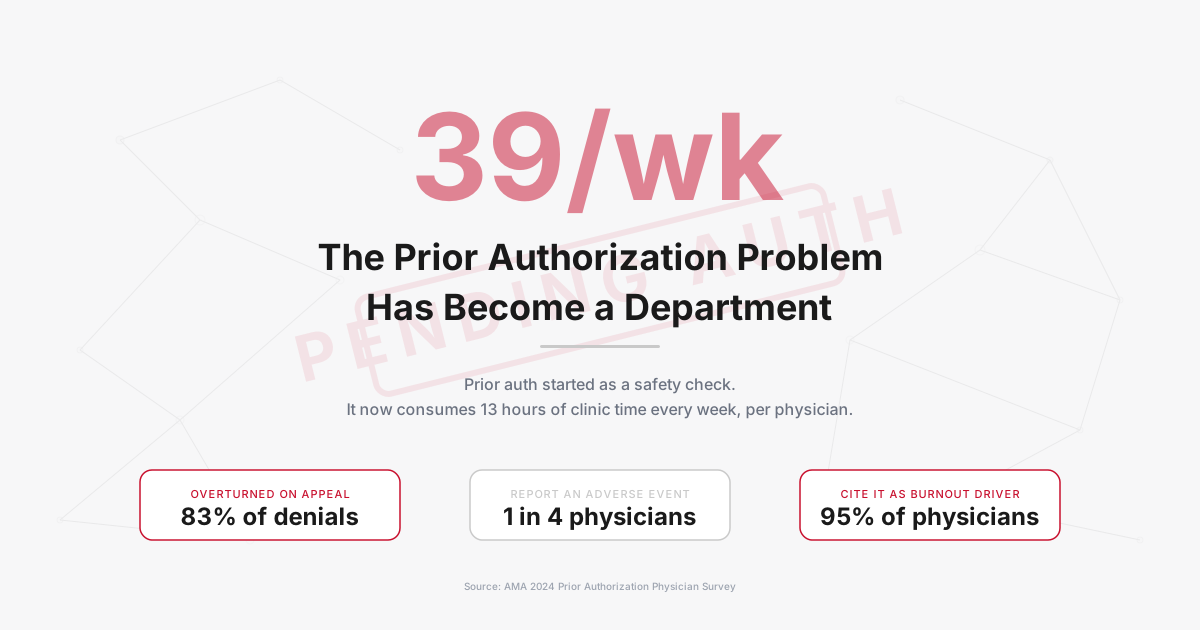
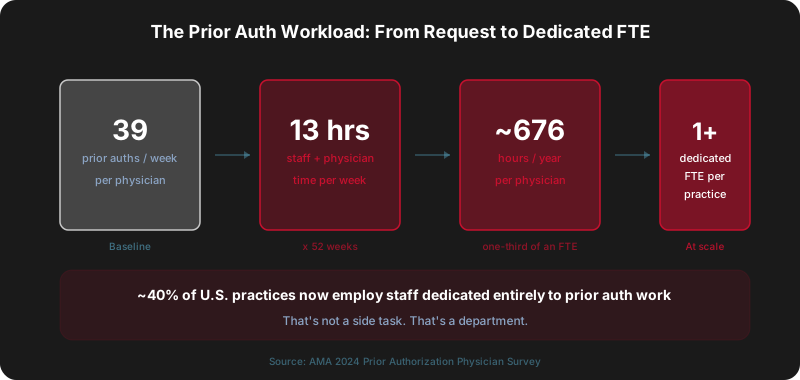
The scale is hard to ignore. The AMA's 2024 physician survey puts the average practice at 39 prior authorizations per physician per week, consuming roughly 13 hours of staff and physician time. About 40% of practices now employ staff dedicated entirely to prior auth work.
That's not a side task anymore. That's an entire department.
The Part We Don't Talk About Enough: Patient Impact
Administrative burden is frustrating, but manageable. What's harder to justify is what happens to patients.
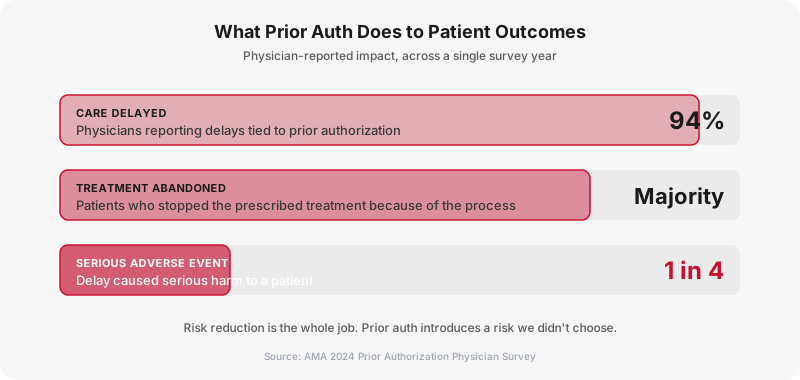
Nearly all physicians in the AMA survey reported care delays tied to prior authorization. A majority said patients abandoned treatment altogether because of the process. About 1 in 4 reported a prior-authorization delay that led to a serious adverse event.
These aren't just numbers. They're the diabetic patient who can't start a GLP-1 on time. The cardiac patient waiting on imaging clearance. The cancer patient whose treatment timeline quietly shifts by two weeks because a fax didn't get routed.
Risk reduction is the whole job. Prior authorization introduces risk we didn't choose and often can't see in real time, until the patient comes back worse.
Why This Hits Practice Owners the Hardest
If you own or operate a practice, prior authorization isn't just a clinical issue. It's a business problem. It shows up in ways that aren't always obvious at first.
Staffing costs that don't generate revenue. Highly capable staff spend hours navigating payer portals, submitting forms, and sitting on hold. That's time not spent on patient care, or anything billable.
Workflow friction. Clinic flow depends on momentum. Prior auth breaks it. Everything becomes reactive instead of streamlined.
Revenue delays. No authorization means no service. No service means no claim. No claim means no payment.
Burnout. Yours and your team's. About 95% of physicians cite prior authorization as a contributor to burnout (AMA, 2024). It's not hard to see why: repetitive, low-control work with high stakes.
To Be Fair, the System Has a Point
It's easy to dismiss prior authorization entirely, but that would miss the nuance.
There are legitimate reasons it exists. Controlling unnecessary healthcare spending. Preventing overuse of high-cost services. Encouraging evidence-based care. In the right context, prior authorization can actually support value-based medicine.
The problem is not the idea. It's how broadly, and how bluntly, it's being applied.
Where Things Start to Break Down
If you've ever won an appeal after an initial denial, you've already seen the cracks in the system.
Most denied prior authorizations get overturned on appeal (AMA's 2024 survey puts the overturn rate around 83%). That raises an uncomfortable question. If it was appropriate all along, what was the denial actually accomplishing?
Other issues compound the problem: requirements applied to low-risk, routine care; poor integration with EHR systems; repetitive documentation requests for the same patient and the same condition; incentives that reward delay more than efficiency.
At scale, this creates something every practice owner recognizes instantly. A lot of work, with very little value.
What Practices That Handle It Well Do Differently
The practices that have prior authorization under control don't try to eliminate it. They manage it intentionally. A few habits show up consistently.
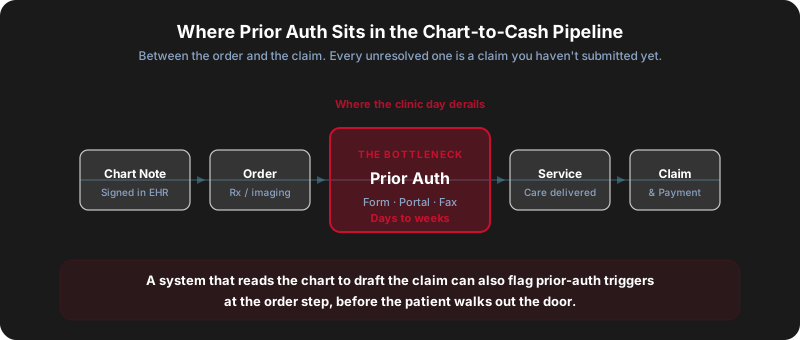
They centralize the function. Instead of everyone doing a little bit of prior auth, a dedicated team handles it: one queue, one set of payer logins, one owner of the backlog. They track which payers delay, which deny, and which approve without friction, and they route work accordingly. They document to the payer's published criteria the first time, not after the denial. They think about prior auth contractually too, using volume and turnaround data as a lever during payer renegotiation. And they treat the whole function as revenue cycle rather than admin, because that's what it is. Prior auth sits directly between the order and the claim. Every unresolved one is a claim you haven't submitted yet.
Where This Is Headed
There's real pressure on the system. Some insurers are trimming requirements. "Gold carding" programs aim to exempt physicians with consistently high approval rates. Automation and AI are entering the space on both sides, for payers and for practices.
Change is slow, and uneven. For now, prior authorization remains a fixed part of the landscape.
The Bottom Line
Prior authorization isn't just paperwork. It's a system that influences when, and whether, patients receive care. It shapes your staff's time and morale. It affects your practice's financial health. And it operates outside your direct control while still shaping your outcomes.
The practice owners who do this well don't ignore it, and they don't just complain about it. They build systems around it, track it, and manage it with the same attention they give to scheduling, billing, and growth.
This is part of why Sovereign RCM is built the way it is. Prior authorization lives inside the same documentation pipeline as coding and claim scrubbing. If an on-premise system can read the chart and draft a compliant 837P from the note, it can also flag prior-auth triggers on the medication list or imaging order before the patient walks out. The goal isn't to eliminate prior auth. It's to stop letting it run the clinic day.
Because in today's healthcare environment, prior authorization isn't going away. But the way you handle it is still entirely within your control.
If you want to see how Sovereign RCM handles prior auth and denial prevention inside a real practice workflow, we can show you.
Sources
- American Medical Association. 2024 Prior Authorization Physician Survey. AMA, December 2024.
- American Hospital Association. Summary of the AMA Prior Authorization Survey. AHA, 2024.
- American Journal of Managed Care. Prior Authorization and Continuity of Care. AJMC, 2025.
- Medical Economics. Inside the Prior Authorization Crisis. Medical Economics, 2025.
- American College of Physicians. Administrative Burden Toolkit. ACP, 2024.
- Centers for Medicare & Medicaid Services. Medicare Advantage Prior Authorization Data. CMS, 2023-2024.
- Office of Inspector General. Prior Authorization Denials in Medicare Advantage. HHS OIG, 2022-2023 reports.
- Sahni et al. Peer-reviewed analysis of prior authorization burden. 2024.
About the Author

Faizan G. Arif, MD
Chief Executive Officer
Board-certified EM physician and the clinical visionary behind Sovereign RCM. Faizan has coded and billed in many busy emergency departments and has had a particular interest in denial patterns stemming from personal experiences as a patient.