AI Insights
Why Most Doctors Bill Below What Their Notes Support

When we started building Sovereign RCM, I did what any data person would do: I pulled billing records from practices we were evaluating and started looking for patterns. I expected to find denial rate problems and claim errors. I did. But the biggest pattern wasn't about claims getting rejected. It was about money that never got billed in the first place.
What Undercoding Actually Looks Like
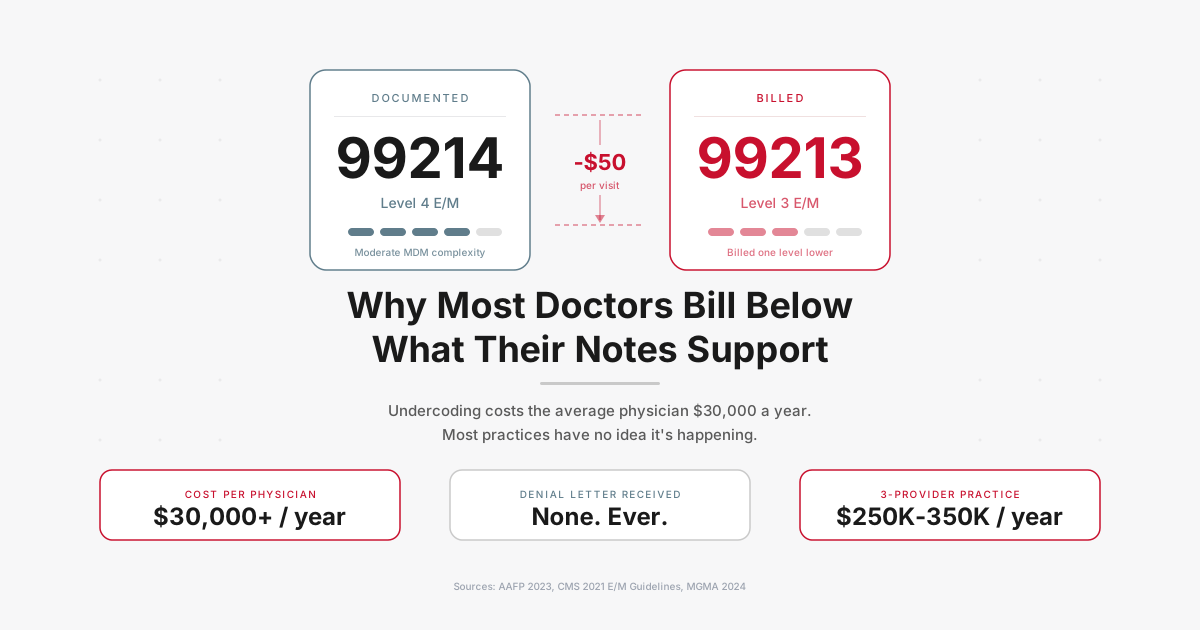
A family medicine physician sees a patient with diabetes, hypertension, and a new complaint of chest pain. She reviews the chart, orders labs, adjusts two medications, and documents a detailed assessment with her clinical reasoning. By the 2021 E/M guidelines, that visit supports a Level 4 code (99214) based on the complexity of medical decision-making.
She bills it as a Level 3 (99213).
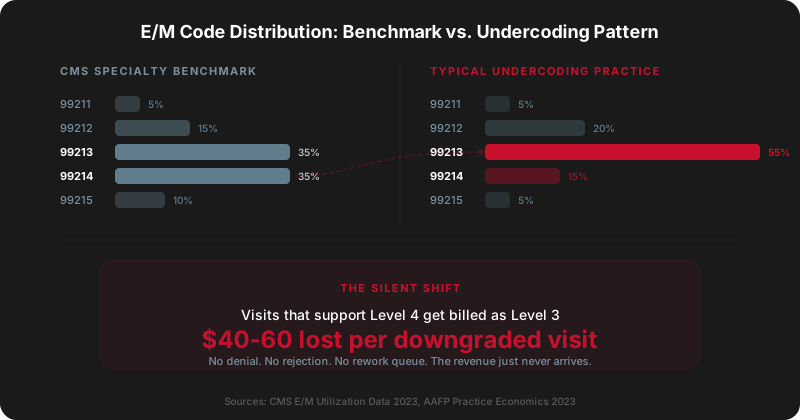
Nobody flags it. The claim goes through clean. The practice collects payment. Everyone moves on. But the difference between a 99213 and a 99214 is roughly $40-60 per visit depending on the payer. For a physician seeing 20 patients a day who undercodes even a third of their visits, that's $80,000 to $120,000 a year in revenue that just evaporates.
AAFP's practice economics data puts the average annual cost of undercoding at $30,000 per family physician. Specialists with more complex coding, like orthopedics and cardiology, often leave more than that on the table.
Why Doctors Do This
It's not laziness and it's not incompetence. The three reasons I see most often in the data are all rational.
Audit anxiety tops the list. CMS recovery auditors (RACs) and private payer audits have created a culture where billing higher feels risky. Doctors would rather leave money behind than defend an upcode to an auditor, even when their documentation clearly supports it. The fear is disproportionate to the actual risk. OIG data from 2024 shows that upcoding audits target a tiny fraction of claims, and well-documented visits almost always survive review.
Then there's muscle memory. Many physicians learned their coding patterns during residency, before the 2021 E/M overhaul that shifted the framework from history-based to MDM-based evaluation. A doctor who trained on the old system might still be coding the way they did ten years ago, even though the rules changed in their favor. The 2021 guidelines actually make it easier to support Level 4 and 5 visits for patients with multiple chronic conditions. But old habits are stubborn.
Time pressure rounds it out. Most physicians spend 15.6 minutes per encounter (per MGMA's 2024 data) and maybe 30 seconds thinking about the code. They pick the level that feels safe and move on. There's no feedback loop telling them they just left $50 on the table. Compare that to a denied claim, which generates a notification, lands in a rework queue, and gets someone's attention.
The Math Gets Ugly Fast
Undercoding is invisible on any single visit, but it compounds across a practice.
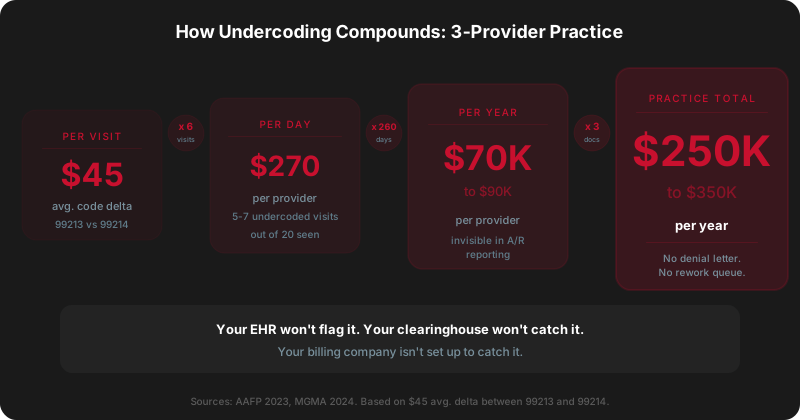
A three-provider group where each doctor undercodes 5-7 visits per day at an average delta of $45 per visit is leaving $250,000 to $350,000 a year uncollected. That's not a rounding error. For many small practices, it's the difference between hiring another MA and not.
And unlike denials, which at least show up in your A/R reporting, undercoding doesn't generate any signal at all. Your EHR won't flag it. Your clearinghouse won't catch it. Your billing company isn't set up to catch it. They process whatever code the physician selects, not the clinical documentation behind it. Reviewing notes against MDM criteria is clinical work, and most billing companies simply don't do it.
How to Find It in Your Own Data
You don't need AI to get a rough picture. Pull your E/M distribution for the last 12 months and compare it to CMS specialty benchmarks. If 70% of your visits are coded as 99213 and the national average for your specialty is closer to 50/50 between 99213 and 99214, that's your signal.
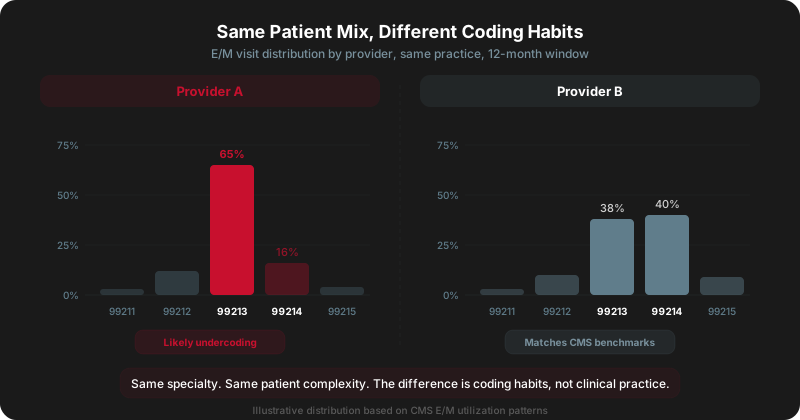
Look at your code distribution by provider, too. I've seen practices where one physician bills 80% Level 3 visits and another bills 50% Level 4 for the same patient mix. The delta almost always comes down to coding habits, not differences in patient complexity.
The harder question is whether the documentation actually supports a higher code. The 2021 E/M framework evaluates medical decision-making across three categories: number and complexity of problems addressed, amount and complexity of data reviewed, and risk of complications or morbidity. A visit that hits moderate complexity in at least two of those three categories qualifies for Level 4. Most practices don't have anyone reviewing notes against these criteria systematically.
What Changes When You Catch It
This is the problem we designed Sovereign RCM to solve, among others. An AI system that reads clinical notes and compares the documented complexity against the billed code can flag the gap before the claim goes out. The physician reviews the suggestion, agrees or overrides, and the corrected claim gets submitted.
It all happens before submission. There's no rework, no amended claim, no audit risk. The documentation supports the code, and the practice simply gets paid what the visit was worth.
If you don't know your practice's undercoding rate, that's the first thing to figure out. Pull your E/M distribution, compare it to benchmarks for your specialty, and see where you land. If the numbers look off, we can help you dig deeper.
Sources
- American Academy of Family Physicians. 2023 Practice Economics Report. AAFP, 2023.
- Centers for Medicare & Medicaid Services. 2021 E/M Documentation Guidelines. CMS, 2021.
- Medical Group Management Association. 2024 DataDive Cost and Revenue Report. MGMA, 2024.
- Office of Inspector General. Medicare Fee-for-Service Compliance Review. OIG, 2024.
- American Medical Association. CPT Evaluation and Management (E/M) Office Visits. AMA, 2023.
About the Author

Ghulam Shah
Chief Technology Officer
AI architect and data strategist at Sovereign RCM. Ghulam has built enterprise data platforms at scale, led ML forecasting models, and turns complex AI into production-grade products.