Practice Management
How Much Revenue Is Your Practice Losing to Claim Denials?

A colleague of mine runs a five-provider orthopedics group outside Philadelphia. Good surgeons, packed schedule, strong patient reviews. When I asked him last fall what his denial rate was, he guessed around 5%.
The actual number was closer to 13%. He had no idea.
Most practice owners don't. Denials show up as line items buried in an RCM report that someone in billing reads and nobody else does. The billing team handles the rework. Some claims get recovered. A lot don't. And the practice keeps running, never quite seeing the full picture of what it's leaving on the table every month.
The Denial Rate Keeps Climbing
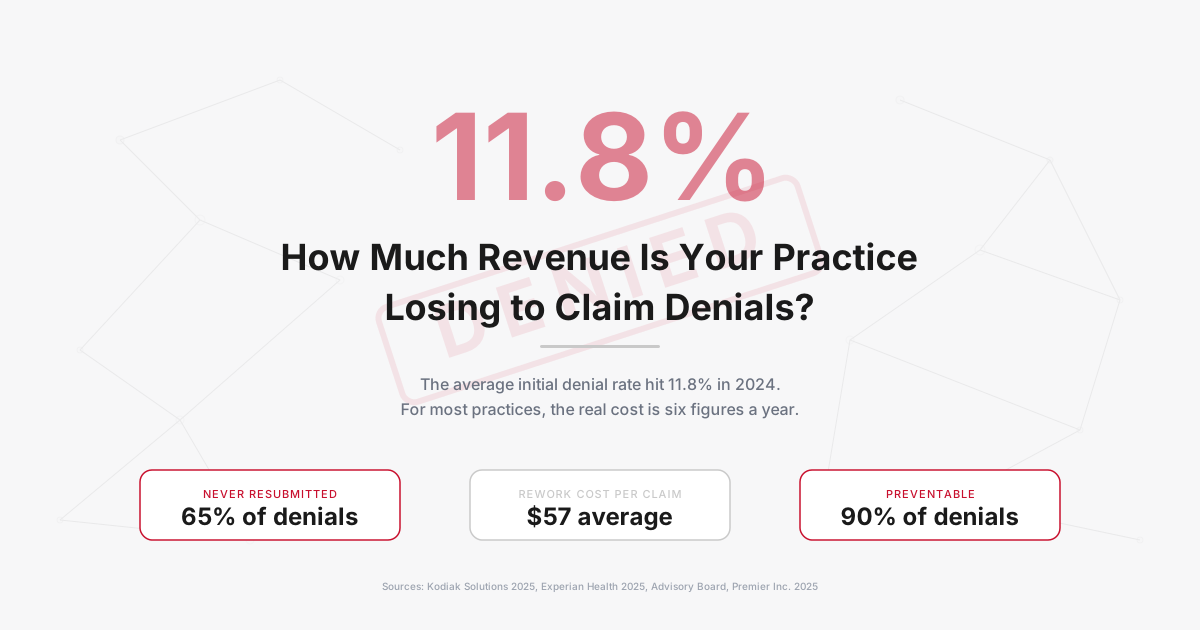
Kodiak Solutions tracks denial data across 2,100 hospitals and 300,000 physicians. Their 2024 numbers put the initial denial rate at 11.8%, up from 10.2% in 2020. Experian Health's 2025 survey confirms the trend: 41% of providers now report denial rates above 10%, and 54% say submitting clean claims is harder than it was a year ago.
Where the Money Actually Goes
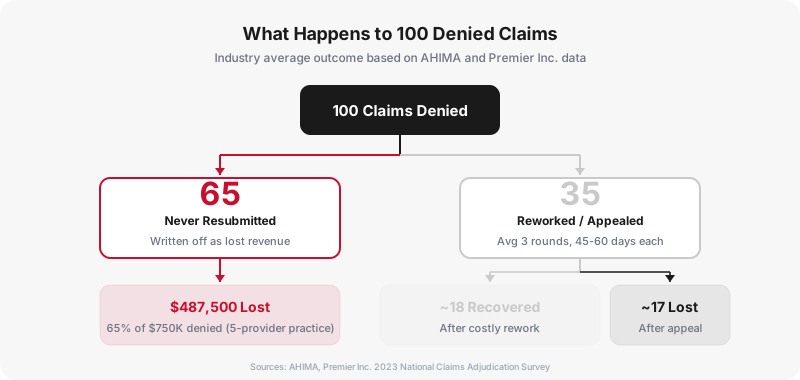
A denied claim isn't just a delayed payment. For many practices, it's a permanent write-off. Up to 65% of denied claims are never resubmitted (AHIMA). The claim gets denied, it goes into a queue, the queue gets long, and the lower-dollar denials fall off the list. Nobody decides to abandon them. They just never make it back to the top.
The ones that do get reworked cost $57.23 each on average (Premier Inc., 2023), up 31% from the year before. Each goes through an average of three rounds of review over 45 to 60 days. And 90% of denials are preventable (Advisory Board). We're spending billions to fix problems that didn't need to exist.
Running the Numbers
Take a five-provider practice collecting $7.5 million a year. At a 10% denial rate, $750,000 in claims hits a wall on first submission. If 65% never get resubmitted, that's $487,500 written off permanently. Factor in rework costs, and the real annual impact lands north of $660,000.
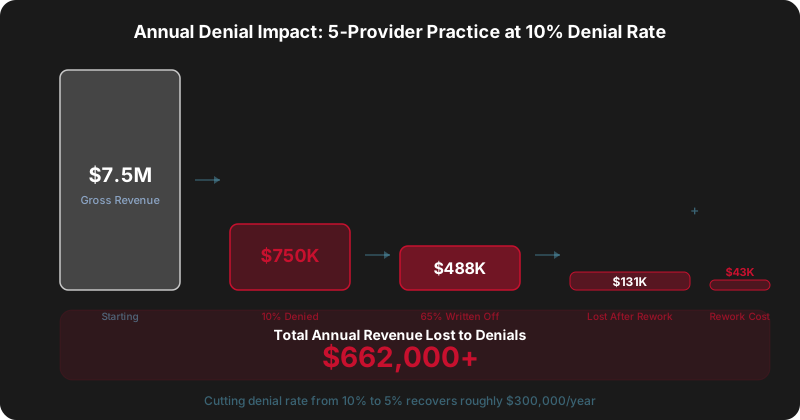
That's close to 9% of gross revenue disappearing into a mostly preventable problem. A practice running at 5% instead of 10% recovers roughly $300,000 a year.
What I See from the Emergency Department
I'm an EM physician, so I see the worst version of this up close. EMTALA requires us to treat every patient regardless of insurance status. We don't verify eligibility before we intubate someone. We treat first and deal with billing afterward.
Payers know this. The most common tactic I see is retrospective downcoding. A patient comes in with chest pain. I work them up properly, document a Level 5 visit because that's what it was. The insurer runs it through an algorithm, sees the final diagnosis was "non-cardiac chest pain," and downcodes it to a Level 3. The documentation supports the higher code. They deny it anyway.
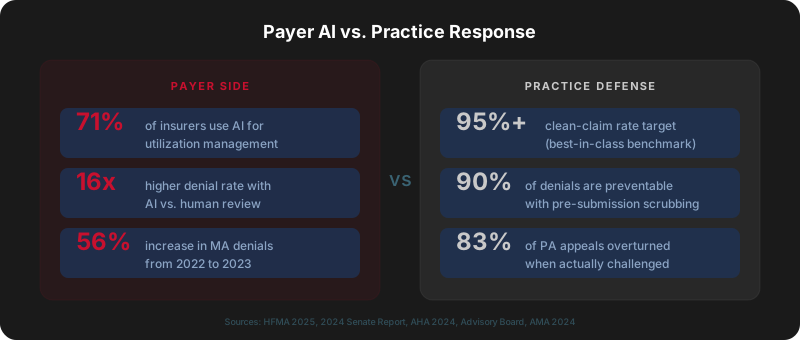
Then there's prior authorization. The AMA's December 2024 survey found the average practice completes 39 prior auths per week, consuming 13 hours of staff time. When physicians do appeal, 83% are overturned. The denials weren't clinically justified in the first place. They were friction designed to make a percentage of providers give up.
Payers Are Automating Denials
HFMA reports that 71% of insurers now use AI for utilization management. A 2024 Senate report found some AI denial tools produce rejection rates up to 16 times higher than human review. Between 2022 and 2023, care denials increased 20% for commercial claims and nearly 56% for Medicare Advantage claims (AHA).
The math is straightforward for insurers: if an AI can deny 16 times more claims per hour than a human, and 65% of those denials are never appealed, the ROI is enormous. You don't beat that with more staff. You beat it with better systems.
What Actually Works
Clean-claim rate is the single most important metric. Catch errors before submission and the denial doesn't happen. Pre-submission scrubbing has to be payer-specific, because a claim that passes CMS edits might still get denied by Aetna under their own modifier rules. And denial analytics should drive prevention, not just recovery.
This is why we built Sovereign RCM. It runs on a physical appliance inside your practice. The system reads clinical notes, identifies the right codes, applies payer-specific rules, and flags denial triggers before the claim goes out. If payers are using AI to deny claims faster, practices need AI to prevent denials faster.
If you want to know what denials are actually costing your practice, we can show you.
Sources
- Kodiak Solutions. Revenue Cycle Denials Index 2020-2024. BusinessWire, May 2025.
- Experian Health. State of Claims Report 2025. Experian Health, 2025.
- Premier Inc. National Claims Adjudication Survey 2023. Premier Inc., 2025.
- Advisory Board. Preventable Denials Study. Advisory Board / HFMA.
- American Medical Association. 2024 Prior Authorization Physician Survey. AMA, 2024.
- American Hospital Association. Payer Denial Tactics. AHA, April 2024.
About the Author

Faizan G. Arif, MD
Chief Executive Officer
Board-certified EM physician and the clinical visionary behind Sovereign RCM. Faizan has coded and billed in many busy emergency departments and has had a particular interest in denial patterns stemming from personal experiences as a patient.